Back to all work

Yext · 2025 · Lead Product Designer

Turning design from a handoff into a shared process.

I led design across three scrum teams on Yext Relate. Design had become a black box: planning guessed at readiness, engineers saw files too late to flag feasibility, and PMs had no view into what was in flight. I rebuilt how design showed up in agile, from kickoff to ship. Handoff satisfaction rose from 48% to 70%, and design was ready one to two sprints earlier.
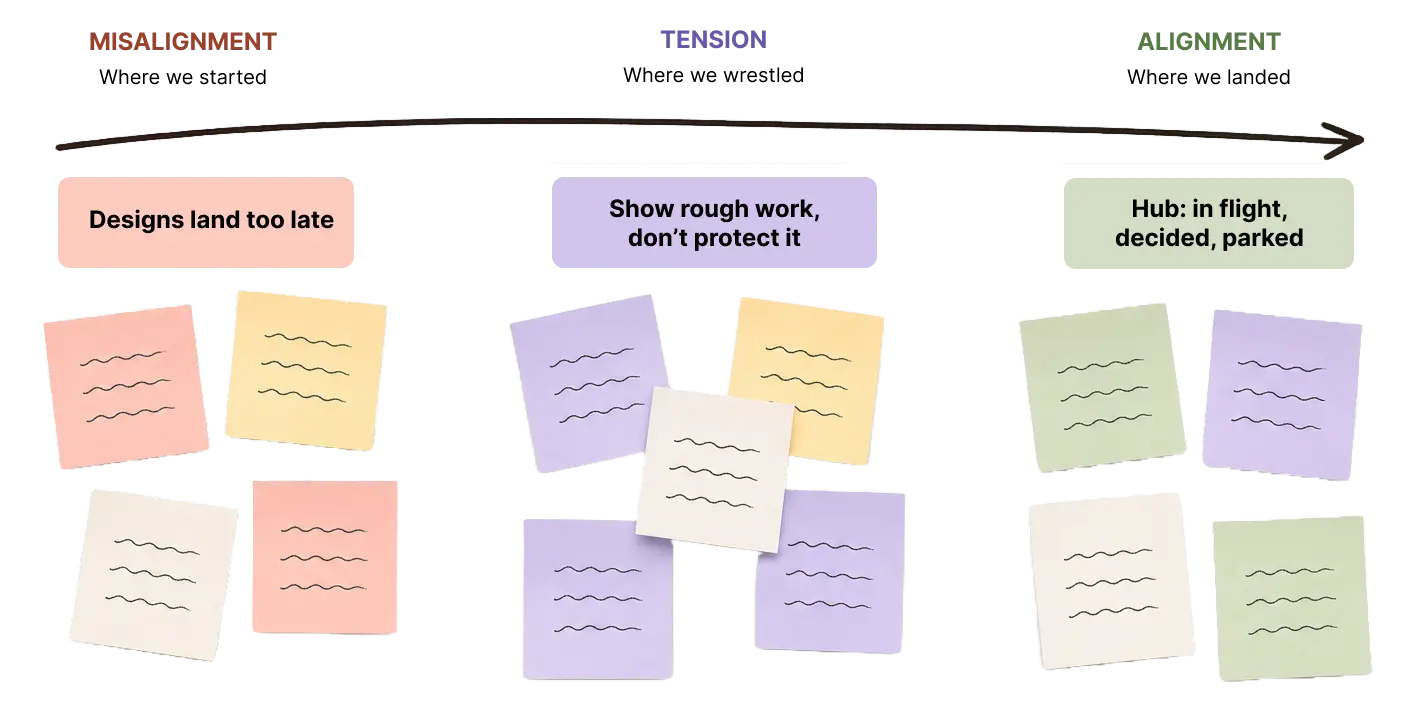
Stylized three-column board distilling the empathy-map session: 'Designs land too late' on the left, 'Show rough work, don't protect it' in the middle, 'Hub: in flight, decided, parked' on the right

Overview

In 2025, I led design on Yext Relate as Lead Product Designer, working across three scrum teams, three PMs, and their engineering leads. The product was moving fast, and the way design, PM, and engineering stayed in sync was about to be tested hard.

My role wasn't to ship one feature. It was to change how design showed up, so that trade-offs surfaced in sketches instead of pull requests, and so that PMs and engineers had real visibility into where design was and why.

Role
Lead Product Designer
Company
Yext
Product
Yext Relate
Year
2025
Scope
3 scrum teams, 3 PMs, engineering leads across each squad

The challenge

Deadline pressure turned a working process into a black box

Several large customer commitments landed in the same window, and the pace they demanded stressed every seam. A team that worked well together started to fray at the edges. Design wasn't intentionally siloed, but without shared rituals or visibility under that kind of pressure, it read that way from the outside. The cracks showed up in the same places every sprint.

  • Planning guessed at readiness. Work got committed before designs were ready, then scope got cut at the last mile.
  • Engineers saw designs too late. Feasibility got raised during implementation, when changing direction hurt.
  • PMs and EMs had no shared view. Nobody outside design could see where the work was, what it was solving, or when it would be ready.

Discovery

Before changing the process, I mapped where the teams actually were

I started with what the teams could tell me. A cross-team survey to size the gaps. An empathy-mapping session to see them from engineering's side. A one-page alignment doc to turn both into rules the PD side could hold itself to.

Cross-team alignment survey

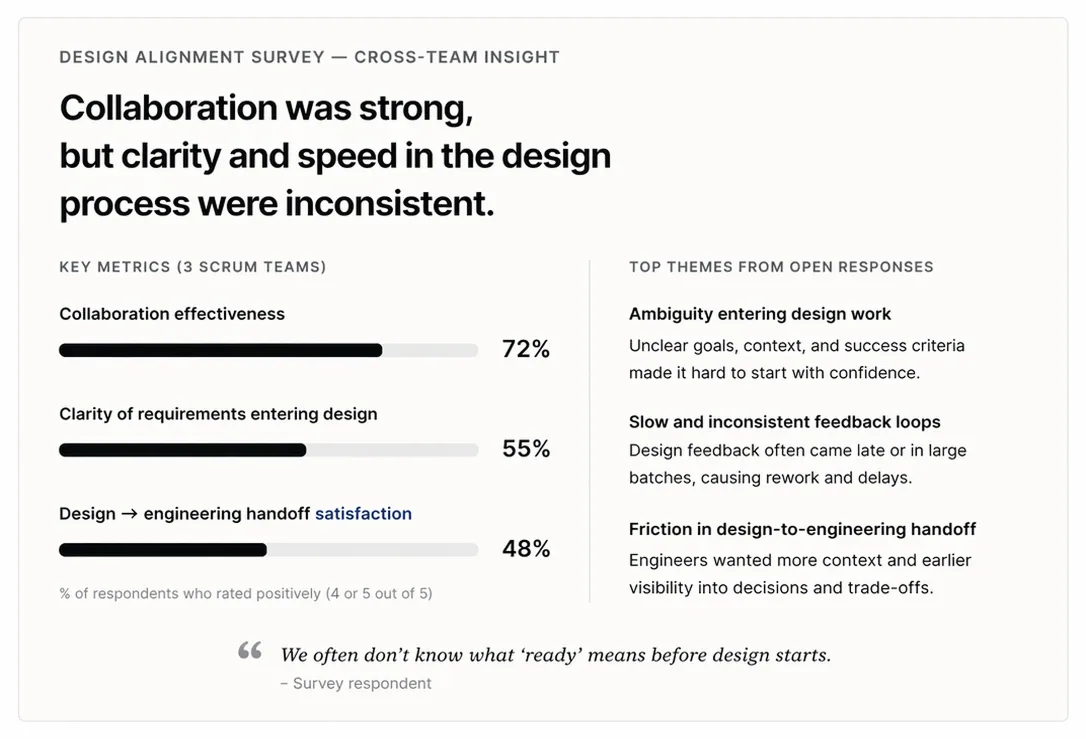
Six responses across design, PM, and engineering, covering workflow, impact, feedback, documentation, and sharing. The numbers told me where to spend.

  • Collaboration was already scoring well at 72 percent.
  • Clarity of requirements entering design sat at 55 percent.
  • Design-to-engineering handoff satisfaction was 48 percent.

Open responses named the same gaps the numbers hinted at: ambiguity at the start of design work, feedback that came late or in batches, and engineers wanting more context before files were final. One respondent put it plainly: "We often don't know what 'ready' means before design starts."

Collaboration didn't need fixing. Clarity and handoff did. The crunch had strained the mechanics, not the relationships.

Cross-team insight from the Relate Design Alignment Survey: collaboration effectiveness 72%, clarity of requirements 55%, design-to-engineering handoff satisfaction 48%, with open-response themes on ambiguity, feedback loops, and handoff friction

Empathy-mapping the eng perspective

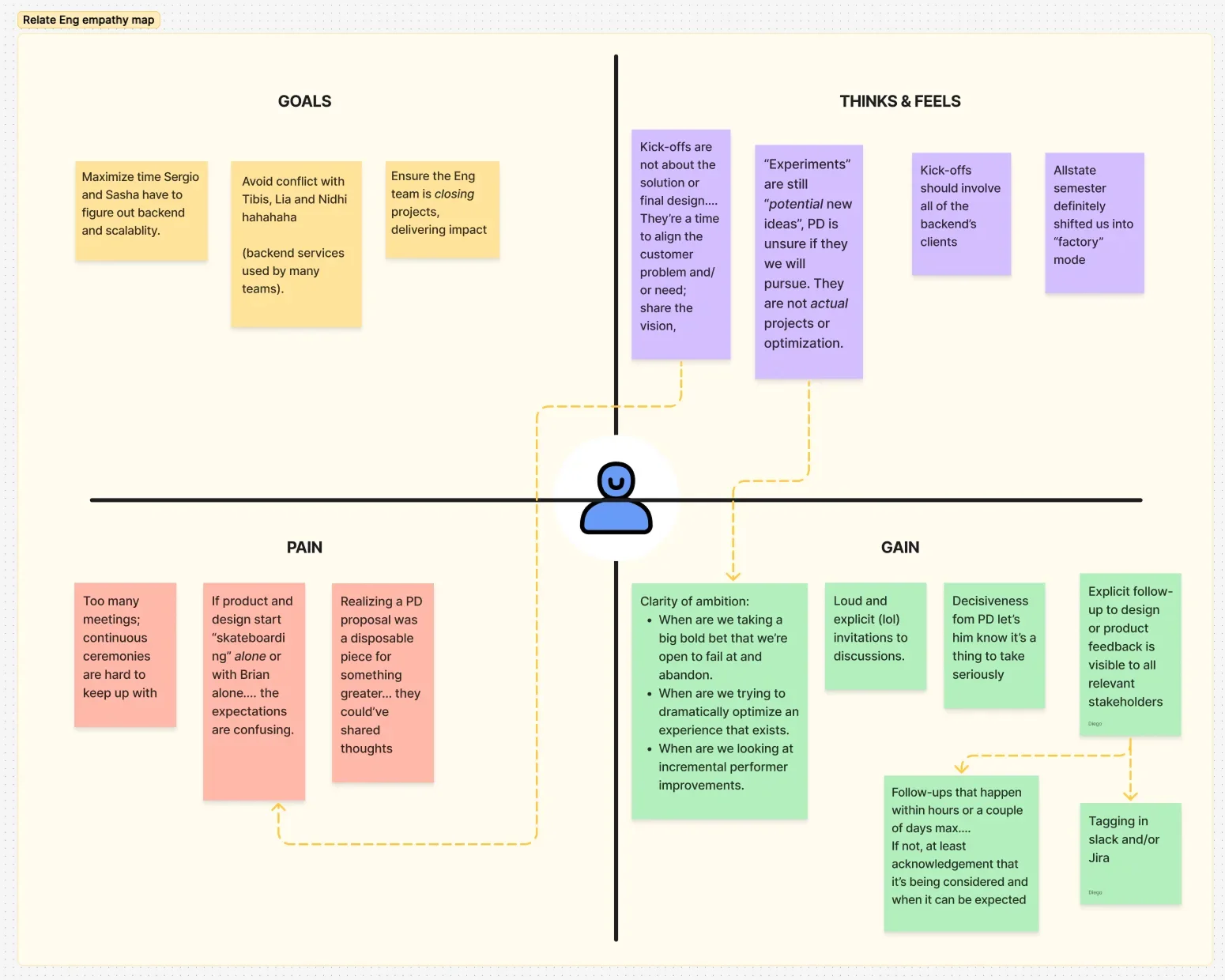
A working session mapping goals, thinks and feels, pain, and gains from the engineering side. The sticky notes got specific fast:

  • "Too many meetings, continuous ceremonies are hard to keep up with."
  • "Kick-offs aren't about the solution or final design. They're a time to align the customer problem and share the vision."
  • "Clarity of ambition: when we're taking a big bold bet, when we're optimizing an existing experience, when we're looking at incremental improvement."

Three things got obvious. Meetings were a tax, not a tool. Kick-offs were being used for the wrong kind of work. And engineering wanted decisiveness from PD, not more options.

Empathy map of the Relate engineering perspective, with Goals, Thinks and Feels, Pain, and Gain quadrants

The "How to win" alignment doc

I turned the map into a one-page doc the PD side could hold itself to. Organized by stakeholder group. Blunt by design. A few of the rules:

  • Focus on the customer need before the constraint. Share early with eng leads so they can challenge or propose.
  • Make invitations to ceremonies loud and explicit. No passive invites, no hoping people show up.
  • When we're talking about future work, acknowledge what it means for what's already in flight: drop, change, or carry on.

Not aspirations. Rules you could call a meeting against.

Decisiveness from PD lets him know it's a thing to take seriously. Empathy-mapping session, Relate Eng

The approach

Four moves to make design open

Engineering in the loop earlier. Evidence in every decision. Design synced to the sprint. Work visible before it hardened.

Nothing on the list is exotic. That's what made it hard: under pressure these are the first practices a team cuts, and every one of them spends time the deadlines said we didn't have. The work was making each move cheap enough that a time-starved team would keep it.

Engineering as partner

Recruiting engineers into the design, not the handoff

Before, engineers saw Figma files at ticket time. By then, the only useful feedback was "this isn't feasible," which was too late to shift direction without pain. So I pulled them in early enough that they were co-authors of the direction, not reviewers of the file.

  • Weekly Design Office Hours. Open invite, no obligation. I brought the open questions, asked for direction feedback, and surfaced risks before committing to them.
  • Early prototyping with the engineer who'd own the build. Rough flows, one question: "does this break anything I can't see?"
  • MVP-scoped proposals, not ideal-state. Every proposal shipped with a must-have spine and a stretch layer, so engineering could see the smallest shippable version on day one.

Trade-offs got made on paper instead of in pull requests. Engineering had room to push back before code existed. Mid-crunch, an open weekly hour looked like a luxury; it was cheaper than one reworked pull request.

His designs often have the pragmatic/expedient option, but he also shares a broader vision engineering can work toward. 2025 peer review
Rod consistently seeks early feedback on designs and workflow mockups, fostering productive discussions between design and engineering. 2025 peer review

Evidence over intuition

Keeping the evidence in the room, not in a quarterly deck

With the baseline in hand, I built rituals that kept the "why" in front of the team sprint to sprint. No decision should rest on "what Rod thinks" when the team already had the data.

Three practices carried most of the weight:

  • User quotes embedded in every design review. Decisions sat next to the pain points they were solving, so the "why" was always visible.
  • Research walkthroughs, not just links. When new findings landed, I went through them with the engineers and kept referencing them wherever they applied, so the context arrived before the decisions did.
  • A living research repo. Usability tests, support tickets, interview notes, all in one searchable place, asynchronous by default.

Design decisions stopped being "what Rod thinks" and started being "what users said last week." Engineers started asking to see the evidence before they saw the designs. And once they held the why, they made the day-to-day calls themselves, the way the research pointed, without waiting for design to be in the room.

Embedded in agile

Joining every ceremony, adding zero meetings

Design falls out of sync with agile if it runs on its own clock. But the obvious fix, a standing design review, was wrong for a team that had just called meetings a tax. Design had to fit inside the time the teams were already spending.

  • Daily standup when I had updates. Not every day, but enough that design was never a surprise.
  • Design reviews inside existing ceremonies, not beside them. A quick walkthrough when refinement had space, a two-minute intro and a link for async feedback when it didn't.
  • Refinement and planning, every sprint, every team. Flagged risks and sequenced design delivery against what was ready to build.
  • Retrospectives. Same format as engineering. What worked, what didn't, what to try next sprint.

By the time a ticket was ready, engineering had already seen the work, asked their questions, and signed off on the direction. No large handoffs, no surprise scope. And with design in the room, the small calls got made in the moment, instead of blocking a ticket while a meeting got found.

Rod's decision to regularly join standups when he had updates improved transparency and kept engineering teams aligned with design work. 2025 peer review
He played a key role in strengthening the collaboration between design and engineering this year. 2025 peer review

Working in public

Opening the black box for everyone else

Recruiting engineers had put the right people in the room. PMs and EMs still had no way in, and the instinct when you lead design is to keep it that way: protect the craft, share the finished work, keep the messy work private. Polish hadn't kept handoff satisfaction from sinking to 48 percent; protecting the craft was protecting the problem. The earlier the work was visible, the faster it got better.

  • Rough drafts in shared Miro and FigJam boards. Not just final comps. Anyone on the three teams could see what I was working through at any stage.
  • A living design hub, updated weekly. In flight, decided, parked, with rationale. One link that answered "where is design on this?" without a meeting or a DM.
  • Sketches and low-fi wireframes before fidelity. Cheap to throw away, easy to argue with, easy to redraw.

Nobody outside design had to ask where the work was; the answer was a link. And because feedback arrived while the work was still soft, most of the hard questions were resolved before high fidelity.

Opening up your work in progress for more frequent feedback from a broader range of stakeholders has actually made you stronger. 2025 peer review

Outcome

The gaps closed. The habits stuck.

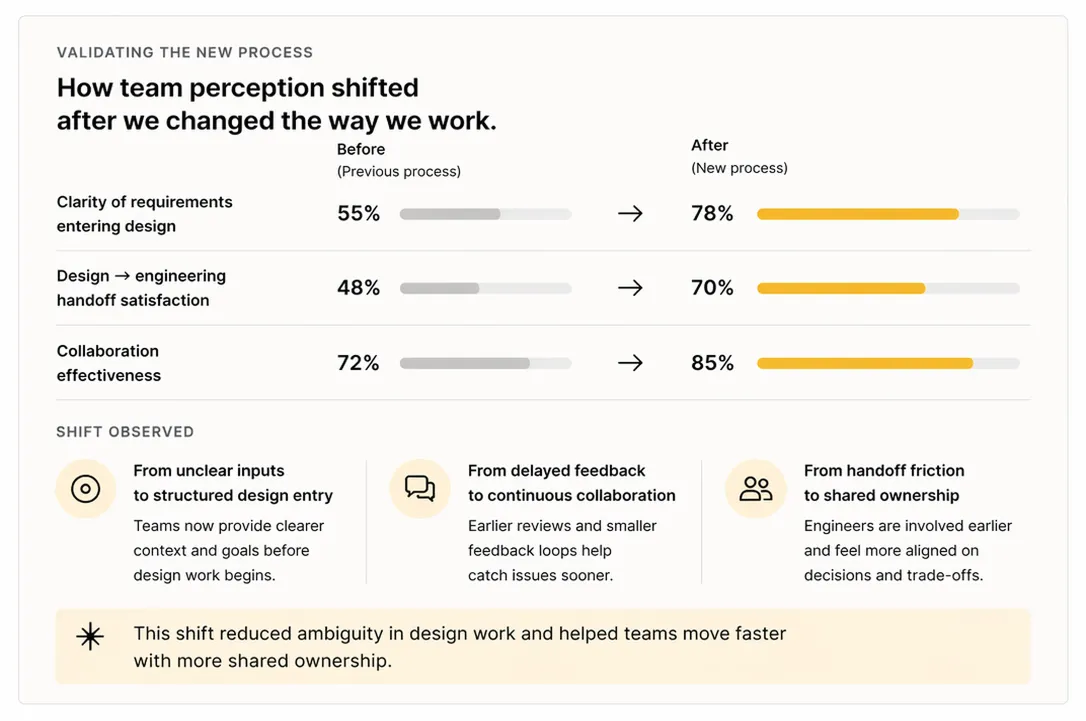
Once the new process had a few sprints behind it, I re-ran the alignment survey. Both gaps the baseline flagged had narrowed by more than 20 points, and the day-to-day matched: fewer late-stage feasibility surprises, and shorter planning, because by the time we sat down to plan, everyone already knew where design was.

48% → 70%
Design-to-engineering handoff satisfaction, the lowest score in the baseline.
55% → 78%
Clarity of requirements entering design work.
1–2 sprints
Design ready earlier in each cycle, sprint after sprint.

The bigger shift was cultural. Three scrum teams with a shared vocabulary for design. Engineers asking for rough drafts instead of waiting for final comps. PMs pulling me into strategy, not just execution.

Re-run of the Relate Design Alignment Survey after the new process. Clarity of requirements entering design rose from 55% to 78%, design-to-engineering handoff satisfaction from 48% to 70%, and collaboration effectiveness from 72% to 85%. Three qualitative shifts: from unclear inputs to structured design entry, from delayed feedback to continuous collaboration, and from handoff friction to shared ownership.
You have high standards for yourself… you're learning how to get your team on that same wavelength, without creating friction or "stoppers" for advancement, but moving alongside them and leading them into doing better things. Diego A. Cabrera, Product Design Manager, Yext
Like what you see? Let's talk.

hello@rod.me